 Electrical Estimating Software
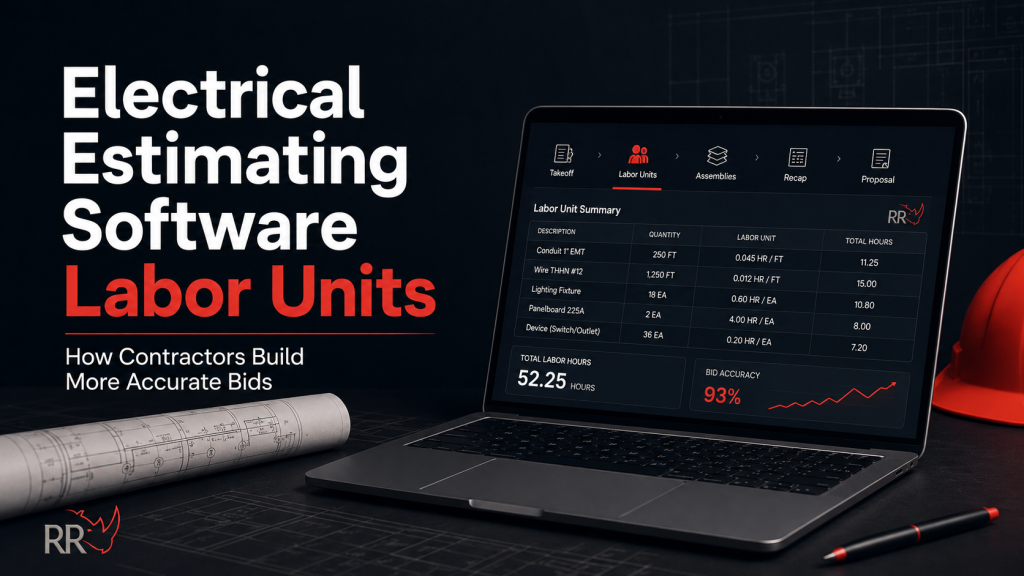
Labor is one of the most important parts of an electrical estimate.
Material pricing matters. Vendor quotes matter. Gear packages matter. But if the labor side of the estimate is rushed, inconsistent, or based only on memory, the final number can look clean on paper and still miss the real cost of the job.
That is why labor units are such an important part of electrical estimating software.
For electrical contractors, estimators, project managers, and owners, labor units help turn a takeoff into a more structured bid. Instead of guessing how long each item may take in the field, the estimator can build from a repeatable labor basis, review the job conditions, adjust where needed, and create a cleaner proposal.
This article explains how labor units work, where contractors commonly lose labor, and how electrical estimating software can help small electrical contractors and midsize electrical businesses build more consistent bids.
What Are Labor Units in Electrical Estimating?
A labor unit is a time value assigned to installing a specific electrical item or task.
For example, an estimator may assign labor to conduit, wire, boxes, devices, fixtures, feeders, switchgear, controls, or other electrical materials. The labor unit helps estimate how much installation time should be included when that item is added to the takeoff.
The goal is not to pretend every job is identical. The goal is to start from a consistent baseline.
A good labor unit structure helps answer questions like:
- How much labor should be included for this material?
- Is this installation normal, difficult, or unusually challenging?
- Does this assembly include everything needed to install the system?
- Are field conditions going to slow the crew down?
- Has the estimate captured both material and labor before the proposal goes out?
Industry references such as the NECA Manual of Labor Units are commonly used as labor estimating resources. NECA describes the Manual of Labor Units as an experience-based reference for estimating labor required to install typical electrical and communications systems.
Electrical estimating software does not remove the need for judgment. It gives the estimator a cleaner way to apply judgment consistently.
Why Labor Units Matter More Than Many Contractors Realize
Many contractors focus first on material because material is visible. You can count fixtures, measure conduit, request gear quotes, and compare vendor pricing.
Labor can be harder to see.
A missing box, an underestimated feeder, or an unrealistic fixture installation time may not stand out until the crew is already on site. By then, the bid has already been accepted, the proposal has already been signed, and the contractor is trying to protect margin during the job.
Labor units help protect against that problem by making labor part of the takeoff process from the beginning.
When labor is connected to the items being estimated, the estimator is less likely to treat labor as a broad percentage or last-minute plug number. That creates a more reviewable estimate and a better handoff from estimating to operations.
How Electrical Estimating Software Uses Labor Units
Electrical estimating software helps connect the takeoff, product catalog, labor units, assemblies, recap, and proposal into one workflow.
In a manual process, an estimator may count material in one place, price material in another place, calculate labor in a spreadsheet, and build the final proposal somewhere else. That can work for simple jobs, but it becomes harder to manage as bids get larger or more detailed.
With software, the process can be more connected.
When an item is added to the takeoff, labor can be included with that item. Electrical estimating assemblies can group related materials and labor together. A recap can help the estimator review material and labor before sending the proposal. A proposal can then be created from the estimate instead of being rebuilt manually.
Red Rhino electrical estimating software is built around this type of workflow, including estimator-entered takeoff quantities, labor units, product catalog, assemblies, detailed recap, and proposal creation.
Where Contractors Commonly Lose Labor in an Estimate
Labor gaps often come from small estimating assumptions or omissions that compound across a project.
1. Treating labor as a percentage instead of a build-up
Some contractors apply labor as a broad percentage or rough allowance. That may feel fast, but it can hide risk.
A small service job, a tenant improvement, a commercial buildout, and an industrial-type installation do not have the same labor conditions. If labor is not tied to actual materials, assemblies, and job conditions, the number may not reflect the work.
2. Forgetting job condition adjustments
Labor units are a starting point. The estimator still needs to think about the real job.
- Is the work overhead?
- Is access limited?
- Is there night work?
- Is the schedule compressed?
- Is the building occupied?
- Are there long material handling paths?
- Are there shutdowns, inspections, or coordination requirements?
Electrical estimating software can organize the estimate, but the estimator still needs to apply experience.
3. Missing small items inside assemblies
Small items can create labor problems when they are missed repeatedly.
Boxes, connectors, supports, fittings, labels, sleeves, grounding details, device plates, and other related components can affect both material and labor. Assemblies help reduce that risk because they group common items together.
This is especially useful for contractors moving away from spreadsheets. Instead of rebuilding common work from scratch every time, the estimator can rely on repeatable assemblies and then adjust for the specific job.
4. Not reviewing labor before sending the proposal
A proposal can look professional while the estimate underneath still has weak labor assumptions.
Before sending the bid, the estimator should review labor totals by system, area, phase, or category. The goal is to catch anything that looks too light, too heavy, or inconsistent with the scope.
A detailed recap can make that review easier because it gives the estimator a better look at how material and labor contribute to the total estimate.
A Practical Estimator Checklist for Labor Units
Before sending an electrical proposal, use this checklist to review labor.
Takeoff review
- Confirm that the major systems have been included.
- Check that feeders, branch, lighting, devices, distribution, low-voltage scope, controls, and special systems are not mixed together without review.
- Look for drawings, addenda, alternates, and specification sections that may affect the scope.
Labor unit review
- Confirm that labor is attached to takeoff items.
- Review whether the labor basis fits the job type.
- Adjust for difficult access, phasing, height, weather, occupied spaces, shutdowns, or unusual installation conditions.
- Make sure labor has not been accidentally duplicated or omitted.
Assembly review
- Check that assemblies include the expected material and labor.
- Review common assemblies for boxes, conduit runs, feeders, devices, panels, lighting, and equipment connections.
- Make sure custom assemblies match the way your crews actually install work.
Quote and vendor review
- Confirm that vendor quotes match the bid documents.
- Review inclusions and exclusions on gear, lighting, controls, and specialty systems.
- Make sure quoted material does not remove labor responsibility from the electrical contractor unless that is clearly stated.
Proposal review
- Confirm that the proposal scope matches the estimate.
- List important inclusions and exclusions clearly.
- Review alternates, allowances, qualifications, and assumptions.
- Make sure the proposal is easy for the customer to understand.
For contractors who want to strengthen the estimating process itself, Hard Hat Industry Solutions also provides educational estimating topics including Labor Units, Material Take-Off, Proposal, Bid Review, and Review Quotes.
How This Looks in a Real Bid Workflow
Here is how a practical labor-unit workflow may look for a small or midsize electrical contractor.
The estimator starts by reviewing the drawings, specifications, addenda, and bid form. Before counting material, they identify the systems being estimated and note any obvious labor concerns such as high ceilings, occupied areas, restricted access, or a tight schedule.
Next, the estimator performs the takeoff. As material is added, labor is included with the items or assemblies. The estimator is not just building a material list. They are building a labor-backed estimate.
After the takeoff, the estimator reviews the recap. This is where experience matters. Do the labor totals make sense for the job? Are there areas that look too light? Did the estimate include job expenses, difficult installation conditions, and vendor quote scope gaps?
Then the estimator reviews the proposal. The proposal should not simply show a price. It should clearly communicate what is included, what is excluded, and what assumptions the contractor made.
Finally, if the job is awarded, the estimate can be used as a better handoff to project management. The team can understand what was included instead of trying to reverse-engineer a spreadsheet after the fact.
That is the real value of a standardized estimating process. It helps the contractor bid with more confidence and manage the job with fewer surprises.
Labor Units Still Need Estimator Judgment
Electrical estimating software can support a stronger process, but it should not be treated like an autopilot button.
A labor unit is only useful when the estimator understands the work. Field conditions, crew skill, project schedule, coordination requirements, local code requirements, and customer expectations all matter.
The National Electrical Code, NFPA 70, is an important standard for electrical installations in residential, commercial, and industrial settings.
Estimating is not only about counting. It is about understanding the work well enough to price the risk.
That is why the best estimating workflows combine three things:
- A structured takeoff process
- Consistent labor units and assemblies
- Experienced review before the proposal goes out
Software helps organize the process. The estimator still makes the judgment calls.
Questions to Ask Before Choosing Electrical Estimating Software for Labor Units
If your company is comparing electrical estimating software, ask practical workflow questions instead of only looking at the sales page.
- Can the software connect material takeoff and labor?
- Does it include labor units when materials are added?
- Can estimators use assemblies for repeatable work?
- Can the team review a recap before sending a proposal?
- Can proposals be generated from the estimate?
- Is the software cloud-based, or does it require downloads?
- Is training available for estimators who are still learning the process?
- Can the company test the software before committing?
Red Rhino is cloud-based, requires no downloads, includes labor units with materials added to the takeoff, and offers a 14-day free trial with no credit card required. Pricing details are available here.
When Contractors Should Move Beyond Spreadsheets
Spreadsheets can work for a while. Many electrical contractors start there because spreadsheets are flexible and familiar.
The problem is that spreadsheets often depend too much on the person who built them.
If only one estimator understands the formulas, the company has risk. If assemblies are copied from old bids without review, the company has risk. If labor is adjusted manually with no clear reason, the company has risk. If proposals are rebuilt separately from the estimate, the company has risk.
Contractors should consider moving beyond spreadsheets when:
- Bids are taking too long to complete
- Estimate review is inconsistent
- Labor is often missed or adjusted late
- Assemblies are not standardized
- Proposals require too much manual rework
- Owners cannot easily review how a number was built
- Project managers do not receive a clear handoff
Electrical estimating software is not just about speed. It is about creating a repeatable estimating process that the business can trust.
Final Thoughts
Labor units are one of the most important parts of an electrical estimate because they connect the takeoff to the real work in the field.
For electrical contractors, better labor estimating can mean cleaner bids, better review, stronger proposals, and a more useful handoff after award. The key is not to remove estimator judgment. The key is to support that judgment with a consistent process.
Electrical estimating software helps by connecting takeoff items, labor units, assemblies, recaps, and proposals in one workflow.
If your company is still estimating with disconnected spreadsheets, manual proposal documents, or inconsistent labor assumptions, it may be time to look at a more structured approach.
FAQ
What are labor units in electrical estimating?
- Labor units are time values used to estimate how long it should take to install specific electrical materials or complete specific electrical tasks. They help estimators calculate labor more consistently during takeoff.
Does electrical estimating software replace estimator experience?
- No. Electrical estimating software helps organize takeoff, labor, assemblies, recap, and proposal creation, but the estimator still needs to review job conditions, scope, difficulty, and risk.
Why do contractors lose money on labor?
- Contractors often lose labor when they miss small scope items, underestimate difficult installation conditions, rely on rough percentages, or fail to review labor before sending the proposal.
Are labor units the same for every electrical job?
- No. Labor units provide a starting point, but estimators should adjust for project type, access, schedule, height, phasing, site conditions, and other job-specific factors.
Can electrical estimating software help contractors move away from spreadsheets?
- Yes. Electrical estimating software can help standardize takeoffs, assemblies, labor review, recaps, and proposals so the estimating process is less dependent on disconnected spreadsheets.
Ready to build cleaner estimates with takeoff, labor units, assemblies, recaps, and professional proposals in one cloud-based workflow?
Start with Red Rhino electrical estimating software.
View pricing and the 14-day free trial.